
Teacher Efi Theodorakopoulou experimented the activity Surface area of a sphere – an experience with oranges with to second-grade students of the Anavryta model high school, in the presence of university students, from the National and Kapodistrian University of Athens, Department of Applied Mathematics. The teaching approach followed an inquiry-based, experiential, and collaborative methodology, aiming to actively engage students and promote deeper conceptual understanding.
Students worked in groups and used oranges as tangible models of a sphere. Initially, they cut the oranges to observe the largest circular cross-section and used it to draw corresponding circles on paper. This step supported the connection between the sphere and the circle.
Subsequently, students carefully peeled the oranges and divided the peel into small pieces. They attempted to place these pieces onto the drawn circles, ensuring full coverage without overlaps or gaps. Through this hands-on investigation, students gradually discovered that the total surface area of a sphere is equal to four times the area of a circle with the same radius.
A = 4 π r 2
The methodology applied is aligned with modern educational practices promoted by European educational frameworks, emphasizing experiential learning, collaboration, and active student participation.
The lesson concluded with reflection and discussion, allowing students to articulate their findings and connect their experience with the mathematical formula. The presence of university students further supported interaction and collaborative learning.
Reflection
This teaching experience highlighted the value of experiential and inquiry-based learning in mathematics education. Hands-on activities helped transform abstract concepts into meaningful learning experiences. The connection between theory and real-life applications fostered deeper understanding and critical thinking. Overall, the approach contributed to increased student motivation, engagement, and participation.
- What worked well in your classroom?
The inquiry-based and collaborative learning approach proved highly effective, promoting active engagement and knowledge construction. - What did students enjoy the most?
Students particularly enjoyed using real-life materials (oranges), which made the concept more concrete and accessible. - What surprised you?
It was noteworthy how quickly students understood the relationship between the sphere and the circle through guided discovery.
Dimitris Bakalis implemented Degrees od Angles in Polygon (Proof of 180° in a triangle) in the Gymnasium of Gerakaswith with 13-years-old students.
The hands-on activity helped students understand the concept of proof in a natural and intuitive
way. They were able to move from simple observation to mathematical reasoning with confidence.
Students were highly engaged throughout the lesson. The use of simple materials made an
abstract concept much more accessible and meaningful.
- What worked well in your classroom?
The hands-on approach, where students cut and rearranged the angles of a triangle, worked very
effectively. It allowed them to verify the result themselves and supported deeper conceptual
understanding. - What did students enjoy the most?
Students particularly enjoyed manipulating the angles and discovering that they form a straight line.
The moment of seeing the result themselves was very engaging. - What surprised you?
It was surprising how quickly students understood the idea of proof through such a simple activity,
even without prior experience with formal reasoning.
Alexandra Valta implemented five differents Lesson Plans in High School of Lykovrisi (Lower secondary) with 13-years-old students.
Degrees od Angles in Polygon (Proof of 180° in a triangle)
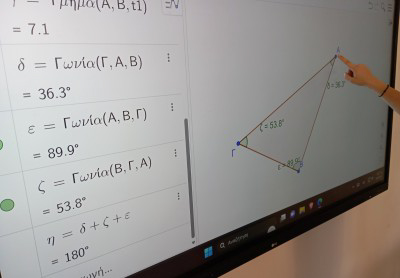
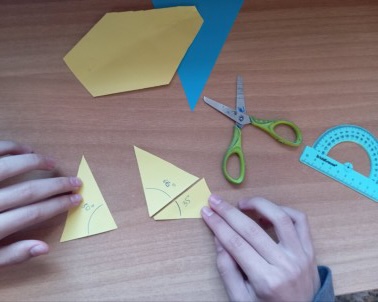
Students showed strong conceptual understanding, even when measurements were not precise.
The use of dynamic tools helped learners move from observation to deeper mathematical understanding.
- What worked well in your classroom?
The combination of hands-on activities (drawing and measuring) with discussion and the GeoGebra activity helped students understand that the sum of a triangle’s angles is always 180°, supporting conceptual learning. - What did students enjoy the most?
Students enjoyed the dynamic GeoGebra activity and the discovery process, where they could observe how the triangle changes while the angle sum remains constant. - What surprised you?
It was surprising that students found it difficult to measure angles accurately, which affected their confidence during the activity but did not prevent conceptual understanding.
Balancing an Equation, other Algebra ‘Basics’
Students became more confident when the lesson shifted to hands-on and game-like activities.
It was interesting to see how prior knowledge influenced students’ willingness to try new approaches.
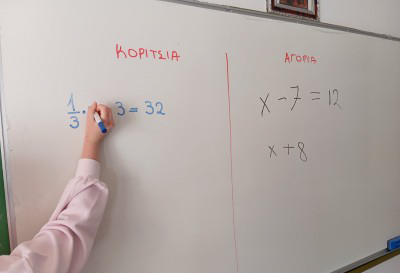
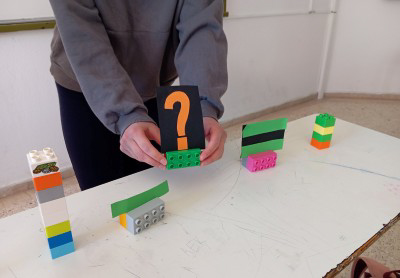
- What worked well in your classroom?
The card-based activity worked well, as it made abstract algebraic concepts more engaging and helped students practice forming expressions in an interactive way. - What did students enjoy the most?
Students enjoyed the card activity the most because it was more playful and allowed them to actively participate in building algebraic expressions. - What surprised you?
It was surprising that students struggled to adopt a new way of thinking about equations, as they were strongly attached to methods they had learned in previous years.
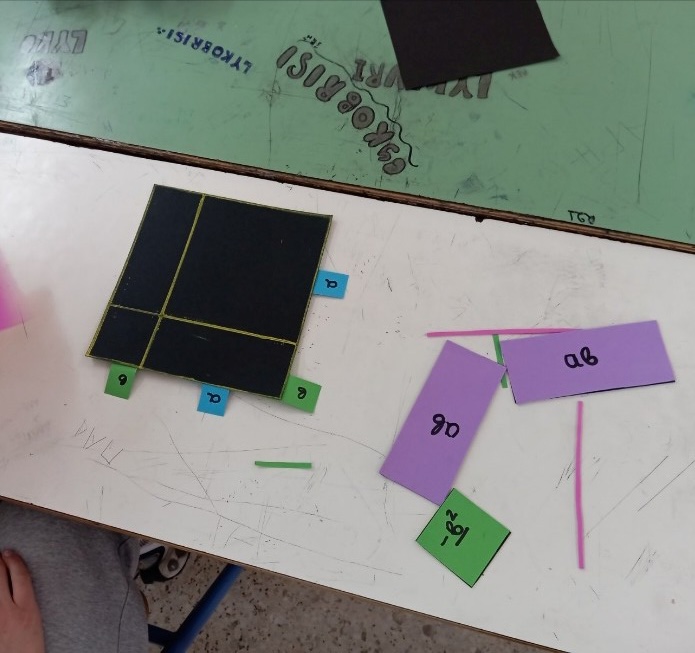
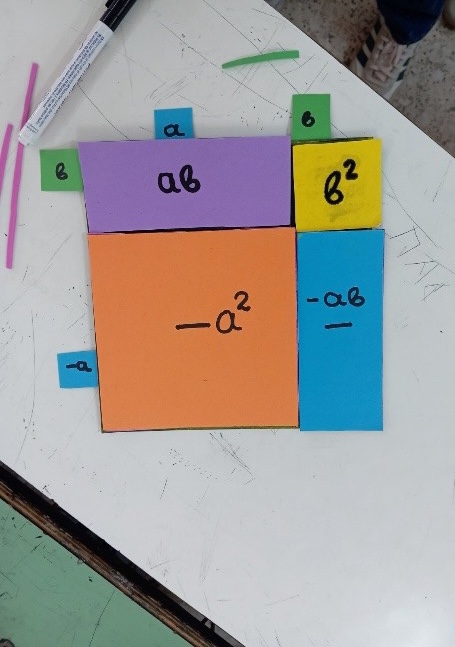
Quadratics
Hands-on materials helped students connect algebraic formulas with geometric meaning.
Students showed deeper understanding by linking expansion with factorization.
- What worked well in your classroom?
The use of hands-on materials worked very well, as it supported the connection between algebra and geometry and helped students develop a deeper conceptual understanding of quadratics. - What did students enjoy the most?
Students enjoyed the visual and exploratory nature of the activity, especially working with materials to build and understand quadratic structures. - What surprised you?
It was surprising that the extension to factorization was smoothly accepted and generated interest, even though it was not initially planned.
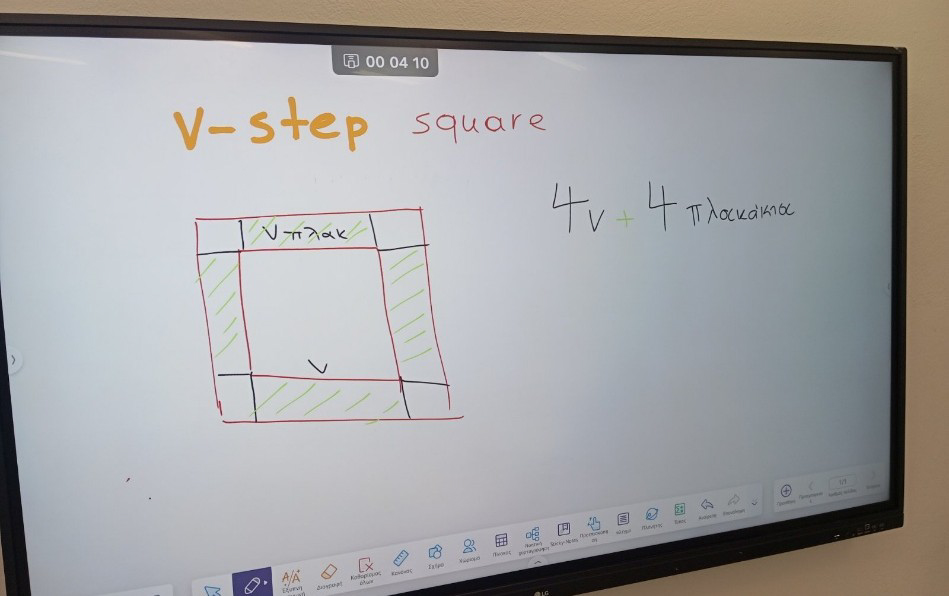
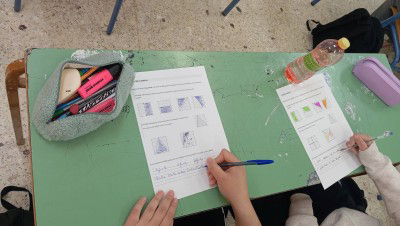
Tilling the Edge: Exploring Patterns around a Plaza
Students developed multiple strategies and confidently explained their reasoning.
The visual and exploratory task supported a strong connection between patterns and algebraic thinking
- What worked well in your classroom?
The inquiry-based and visual approach worked very well, as it encouraged students to explore patterns, compare different strategies, and move from concrete representations to algebraic expressions. - What did students enjoy the most?
Students enjoyed discovering that there were multiple ways to solve the problem and experimenting with different strategies, especially during the second part of the activity. - What surprised you?
It was surprising that the search for patterns motivated even lower-performing students to participate actively and confidently.
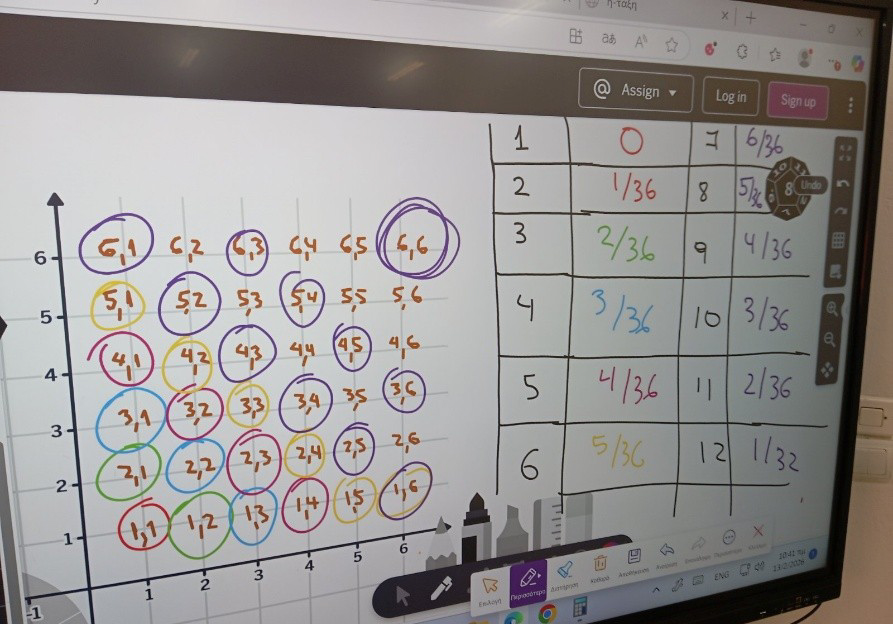
Laplace’s Rule
The game-based approach significantly increased student engagement and deepened their understanding of probability.
Students moved from misconceptions to clear reasoning through experimentation and discussion.
- What worked well in your classroom?
The combination of experimental activities (dice rolling) and discussion worked very well, helping students connect theoretical probability with real outcomes and develop a deeper conceptual understanding. - What did students enjoy the most?
Students enjoyed the game-like, competitive element of rolling dice and predicting outcomes, which made learning more interactive and engaging. - What surprised you?
It was surprising that many students initially believed all sums from two dice had equal probability, but this misconception was effectively addressed through the activity.